The PM Soft Skills That Actually Matter (And the Ones That Don't)
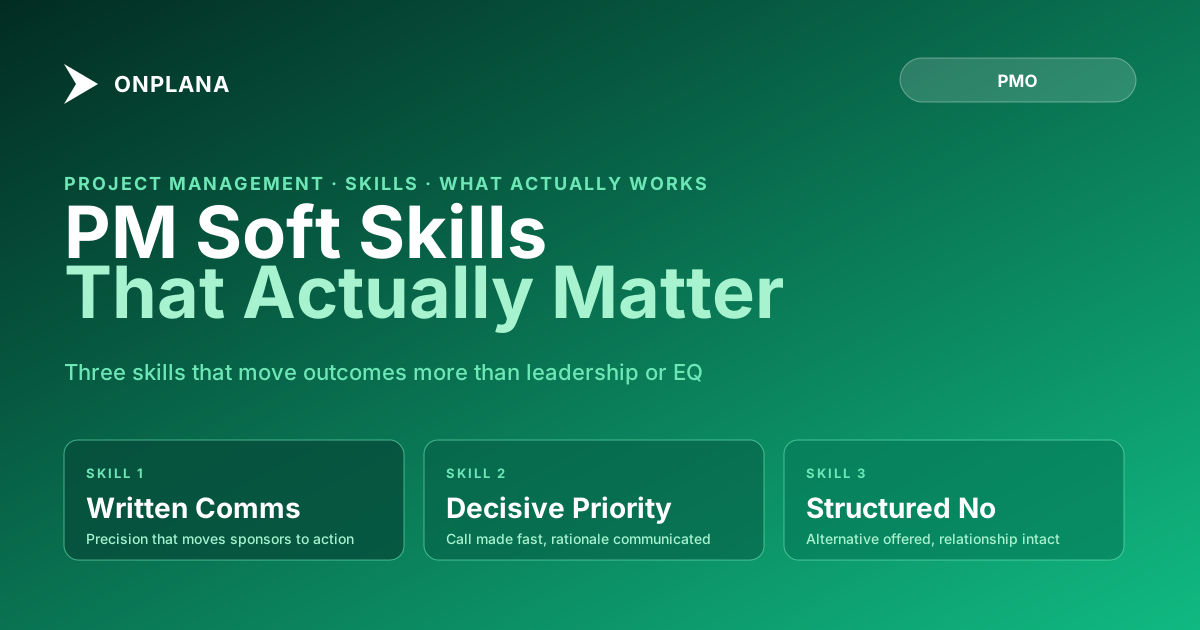
The project manager soft skills that move outcomes aren't leadership or EQ. Written communication, decisive prioritization, and saying no are the real ones.
Here is the uncomfortable version of the PM soft skills list. The training says: communication, leadership, emotional intelligence, team building, problem solving. Every list includes them. None of them are wrong exactly. The problem is that they are not specific enough to act on, which means they cannot be developed on purpose. "Communicate better" is not a skill. "Write a status report that moves the sponsor to make a specific decision" is a skill.
The project manager soft skills that actually separate PMs who deliver from PMs who explain why things are delayed are more specific and less flattering. They are not the interpersonal attributes most training sells. They are precision in writing, speed in prioritization under pressure, and the discipline to say no with a structure that does not burn the relationship. These are teachable. They are not what most PM development programs teach.
TL;DR. Three project manager soft skills move outcomes more than everything else on the standard list: written communication precision (not just "communication"), decisive prioritization under resource pressure (not just "leadership"), and structured saying no with a built-in alternative (not just "conflict management"). The rest of the list describes good people, not high-performing PMs.
What the standard soft skills list gets wrong
The standard list appears on every PM job description: leadership, emotional intelligence, communication, problem-solving, team building. None of these are wrong as aspirational attributes. The problem is that they are too abstract to develop through deliberate practice. "Leadership" describes thousands of different behaviors depending on context, organization, and team. A PM cannot practice "leadership" in the way a surgeon can practice a suture technique or an engineer can practice a debugging method.
The reason these attributes dominate PM training is that they are defensible: nobody argues against leadership or emotional intelligence. They are also proxy descriptions for outcomes rather than specifications of behavior. A PM who delivers on time and under budget "has strong leadership." A PM who misses the deadline "lacked stakeholder management." The attribution runs backward from outcome to trait, which does not help the PM who wants to get better before the outcome is known.
The traits that actually differentiate high-performing PMs are narrower and more embarrassing to teach. Embarrassing because they require acknowledging specific gaps: this PM writes status reports that generate confusion rather than decisions, this PM avoids difficult scope conversations until the project is already compromised, this PM defers priority calls in ways that cost the team days of lost direction. Naming these gaps specifically is more useful than training on "communication" as a category.
Written communication: the project manager soft skill nobody teaches first
Written communication is the highest-leverage skill a PM can develop, and it is almost never the first one trained. PMs operate primarily through written artifacts: status reports, meeting notes, decision memos, change requests, risk summaries, and escalation notes. Every one of these is either clear enough to move the reader toward a specific action or vague enough to require a follow-up conversation. The PM who writes clearly shortens every decision cycle. The PM who writes vaguely extends every decision cycle by at least one meeting.
The specific behaviors that separate precise PM writing from vague PM writing:
Front-load the decision or action. Most status reports bury what the reader needs to do in paragraph four, after three paragraphs of progress narrative. The sponsor who receives a status report should know by the second sentence what they are being asked to decide or approve. Move the ask to the top.
Name risks in concrete terms. "There are concerns about the timeline" is not information. "If the API is not available by October 15, the delivery date moves to December 3" is information the sponsor can act on. Concrete specificity is not pessimism; it is precision that allows a response.
Write to the audience who will act, not the audience who attended the meeting. A status report written for a sponsor needs to convey what to decide. A status report written for a project team needs to convey what to do next week. The same facts require different framing for different readers. Most PM status reports are written for an undefined middle audience and serve neither reader well.
The return on this skill is compounding. A PM who writes clearly needs fewer escalation meetings because the sponsor already has the information. Fewer meetings mean more execution time. The PM who writes vaguely generates confusion that converts into meetings, which converts into less time for actual project management. See status report writing guide for practical guidance on format and content.
Decisive prioritization under pressure
Prioritization is not the quarterly planning exercise where the team has a whiteboard and a full afternoon. It is the Tuesday at 3pm when three tasks are due Thursday, two people are blocked waiting for a decision, and a senior stakeholder just added a request the team did not plan for. The PM who hesitates loses: the team does not know what to do, two people start on conflicting tasks, and the decision gets made by whoever is most persistent rather than by the PM.
Decisive prioritization under pressure requires preparation before the pressure arrives. The specific behaviors:
Have a decision framework before the crisis. The PM who develops priority criteria during a resource conflict is already too slow. Before the project is in execution, answer: what breaks the project if it slips? What can slide a week without consequence? What has an external deadline that cannot move? These answers reduce a crisis-moment decision to a lookup rather than an analysis.
Make the call with the information available. Waiting for more data is sometimes the right call; more often it is a way of avoiding accountability for the decision. A call made now with 80% of the information is usually better than a call made tomorrow with 90%, because the cost of delay is borne by the team in lost time.
Communicate the rationale explicitly. A team that does not understand why Task A was prioritized over Task B will relitigate the decision the next time they face pressure. A two-sentence explanation of the reasoning builds the team's ability to make consistent calls without escalating every conflict.
The most common failure mode in prioritization is treating it as a consensus process. Consensus is appropriate for decisions that require buy-in across a team or that will affect people who are not at the table. Tactical prioritization under resource pressure is a PM decision. The PM can consult; the PM decides. Teams that wait for consensus on tactical prioritization lose hours and sometimes days.
Saying no without burning the relationship
Saying no is the hardest skill on this list and the most undertrained. A flat refusal ends the negotiation but creates resentment. "We cannot add that" closes the conversation but leaves the requestor without an alternative, which means they will come back through a different channel or apply organizational pressure until the answer changes. The PM who says no without structure does not protect scope; they delay the scope conversation until it is more expensive.
The structure that works:
First, acknowledge the request and its value. "That feature would genuinely help the end users" is not capitulation; it is an acknowledgment that builds the good faith the next step requires.
Second, name the cost in concrete terms. "Adding it to this sprint costs three days of development time, which moves the integration testing start from Monday to Thursday." Concrete cost is harder to dismiss than abstract "we don't have capacity."
Third, offer a specific alternative. "We can add it to next sprint, which means it ships two weeks after the main release. Or we can defer the analytics dashboard to make room for it in this sprint. Which would you prefer?" This is not a negotiation trick. It is a genuine offer that lets the requestor make an informed choice about what matters more.
Fourth, let the requestor choose. The PM's job is to surface the tradeoff. The requestor's job is to decide which side of the tradeoff they prefer. If the feature is worth what it costs, they will say so and you will both understand what you are trading. If it is not, they will defer it without losing face, because the PM gave them a choice rather than a refusal.
This structure works for scope creep, resource conflicts, and priority fights across the stakeholder landscape. For the specific conversation scripts that handle the most common scope negotiations, see scope creep conversations script.
Skills that get more attention than they deserve
Conflict management: conflicts between teammates are usually a symptom, not a cause. Two developers in conflict about an architectural decision are usually in conflict because the decision was not made clearly when it should have been, or because accountability for the outcome is ambiguous. Fix the process that created the ambiguity (decision rights, scope boundaries, priority order) and the conflict resolves. Managing the conflict in isolation produces temporary peace and recurring incidents.
Team building: important at long horizons, but most PM project teams are not long-horizon. Team members rotate, contractors roll off, and the PM inherits teams mid-project more often than they staff them from scratch. The skills that survive project handoffs and rapid team changes are process clarity and written communication, not interpersonal rapport. A new team member can get up to speed on a well-documented project. They cannot inherit a relationship the previous PM built over six months.
Emotional intelligence: measurable, real, and largely stable by adulthood. EQ training programs typically produce self-awareness exercises rather than behavior change in the delivery-relevant behaviors they aim at. The PM behaviors EQ training targets, reading whether a sponsor is actually aligned or just agreeable, calibrating how much context a given stakeholder needs, not reacting defensively to a challenge in a steering committee, can be developed directly through practice and reflection without going through a personality framework.
What emotional intelligence actually means in PM practice
EQ shows up in PM practice in three specific ways. First, knowing when to push and when to back off: a sponsor who gives a vague "yes" in a meeting and goes quiet afterward is often not aligned; the PM who reads that signal and follows up before the decision reaches the steering committee saves a crisis. Second, calibrating communication style: a CFO needs cost exposure framed in financial terms; a technical lead needs risk framed in architecture terms; the same risk presented to both audiences needs different language. Third, not reacting defensively to challenge: a PM who hears "the schedule is wrong" and responds with data rather than justification builds more sponsor trust than one who defends.
These are genuine skills. The path to developing them runs through project experience and deliberate retrospection rather than workshops on emotional styles. The specific practice: after every important conversation where the outcome surprised you, ask what signal you missed. Before a difficult conversation, write out what you expect the other person to say and what the likely reason is. After a failed escalation, trace back to the moment where the sponsor's perspective diverged from yours and identify the earliest point where you could have addressed it. These build the pattern recognition that EQ describes. See escalation framework for PMs for a structured approach to escalations that applies this kind of EQ thinking to specific situations.
Skills comparison: what training covers vs what moves outcomes
Building the project manager soft skills that move outcomes
These three skills are not developed in workshops. They develop through deliberate practice with specific feedback on specific outputs. Write every status report as if the PM who made a specific decision would be judged on how clearly that decision was communicated. Practice the "yes, but here is what moves" structure in every scope negotiation, even small ones, until the structure is automatic. Make a prioritization call without consensus once a week and track whether the team lost time because of it or because of the call itself.
The PMO Maturity Assessment covers communication, prioritization, and scope governance as explicit dimensions of PMO capability. If you want a structured view of where your team currently sits on these capabilities, compared against other PMOs of similar size and industry, it provides a capability profile across all three dimensions in about ten minutes.
Run the free PMO Maturity Assessment Twenty questions about your PMO's communication, prioritization, scope governance, and decision authority. Get a capability profile in about ten minutes. No signup required. → Open the assessment
Ready to make the switch?
Start your free Onplana account and import your existing projects in minutes.