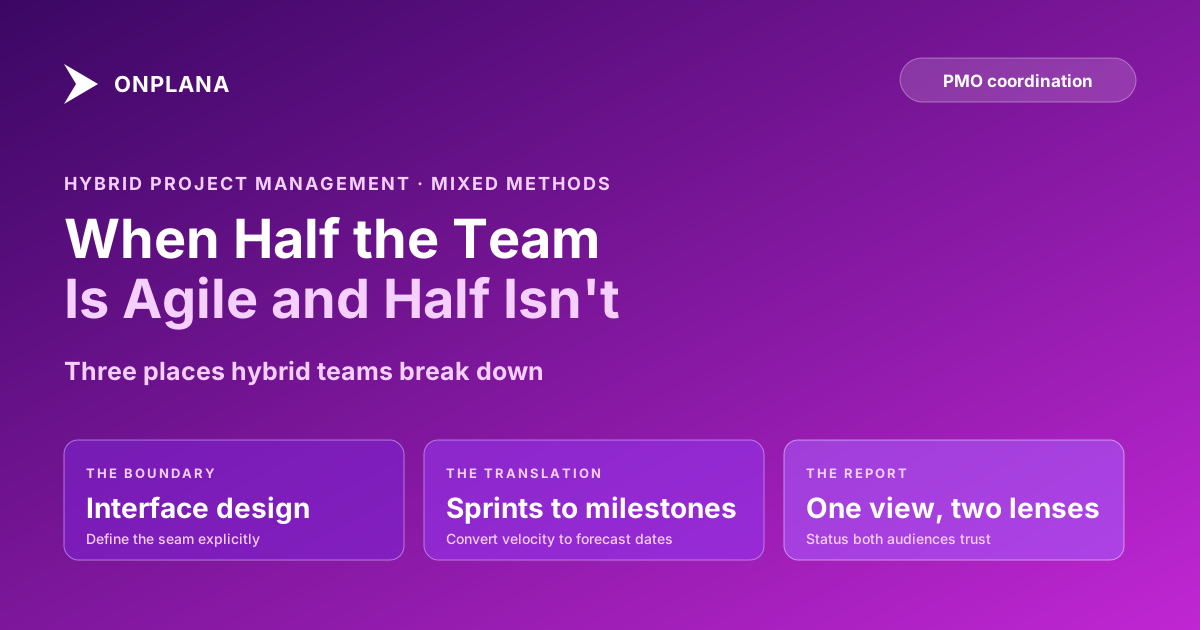
Hybrid Project Management: When Half the Team Is Agile and Half Isn't
Your agile team and your waterfall team are in the same project. Hybrid project management breaks at the seams between them, and most PMOs fix the wrong thing.
Here is the pattern. The project manager schedules the Monday standup at 9 AM. Half the team shows up. They give three-sentence status updates: done, doing, blocked. They leave. The other half arrives 30 minutes later for the waterfall milestone review: critical path status, risk register update, integration gate sign-off. Nobody planned for both groups to be in the same project. But they are, and the coordination cost runs through the cracks between the two systems.
Hybrid project management is the standard reality for teams delivering software-dependent work where the engineering component runs in sprints and the regulatory, hardware, or customer-facing components run against a fixed milestone schedule. The phrase "hybrid" rarely reflects a deliberate methodology choice; it reflects the reality that two halves of a team defaulted to the approach that made sense for their work, and nobody built the bridge between them.
The failure mode is not that agile and waterfall are incompatible. They are not. The failure mode is treating the boundary between them as someone else's problem. When the boundary is unmanaged, sprint work does not translate to milestone forecasts, status reports give sponsors two incompatible views of the project, and scope changes approved in one half of the team create unreviewed work in the other.
TL;DR. Hybrid project management works when the seam between methodologies is explicitly designed rather than ignored. The coordination problems that sink hybrid teams cluster at three points: the handoff between sprint output and waterfall milestones, the reporting interface where metrics do not translate, and the decision process for scope changes that cross the boundary. Standardize those three things and the rest largely manages itself.
What hybrid project management is (and what it isn't)
Hybrid project management is not a methodology. It is a coordination problem. Methodologies describe how a team organizes work within a boundary; hybrid describes what happens when two methodologies share a project boundary.
The most common structure: a software engineering team runs two-week sprints using Scrum or a Kanban variant. The same project includes one or more waterfall components: hardware procurement with lead times, regulatory submissions with fixed dates, integration testing phases that cannot start until the software sprint is complete, or third-party vendor deliverables on a fixed contract schedule. The PM manages both.
What hybrid project management is not: a methodology that simply combines "some agile practices with some waterfall practices" at the individual PM's discretion. That informal hybrid produces teams that are neither rigorous enough to run proper sprints nor structured enough to track a critical path. It is the worst of both worlds. Hybrid that works is explicit about which component uses which methodology and builds a defined interface between them.
For a ground-up comparison of the two methodologies and when each works on its own, see the waterfall vs agile guide. The hybrid question is downstream of that: once you know both methodologies well, the coordination challenge becomes the interesting problem.
Where hybrid project management actually breaks down
Three failure modes appear repeatedly in hybrid projects. They are not tool failures; they are interface failures.
1. Sprint output does not connect to milestone forecasts. The engineering team finishes sprint 6 and closes 22 story points. The sponsor asks when the integration milestone will be ready. The PM cannot answer because no one built the formula that converts sprint velocity into a milestone forecast. The sponsor loses confidence in the timeline. The engineering team cannot understand why their consistent delivery is being met with concern.
2. Status reports give sponsors two incompatible views. The agile half of the team uses burndown language: velocity is strong, 18 points remain, finish expected by sprint 8. The waterfall half uses milestone language: milestone 3 is green, integration is 12 days out. The status report that summarizes both reads like a document from two different projects. Sponsors cannot tell whether the project is healthy.
3. Scope changes get approved in one half and create unreviewed work in the other. A sponsor approves an enhancement request in the steering committee, which is a waterfall governance forum. The enhancement requires three sprint cycles of engineering work. The change was approved without consulting the sprint backlog, which is now overloaded. The Scrum team learns about the change at the next sprint planning and has to renegotiate two deliverables nobody knew were affected.
All three failures have the same root cause: the interface between the two methodologies was not designed. The diagram below shows where the interface needs to be built.
What to standardize across the hybrid project management boundary
You do not need a unified methodology. You need a unified interface. Three things standardized at the boundary fix most hybrid coordination failures.
Definition of done at integration points. Each point where the agile component hands off to the waterfall component (or vice versa) needs a written, agreed definition of done. Not "software complete" but "all sprint stories in the integration backlog accepted by QA, API contract tests passing, and documentation draft approved by technical writer." Integration milestones that depend on vague handoff criteria slip every time.
A single scope change log regardless of methodology. When a sponsor approves a scope change, it gets logged in a single place that both the Scrum team's backlog owner and the PM's risk register can see. Every scope addition gets a required-by-sprint estimate from the agile lead and a milestone impact estimate from the PM before approval. This is not bureaucracy; it is the minimum information needed to make a scope decision honestly.
Hard constraint dates that both teams treat as non-negotiable. The regulatory submission date, the hardware order cutoff, the client acceptance event: these are dates the sprint schedule must be arranged around. They are not waterfall artifacts; they are project constraints. Make them visible in the sprint tool, not just on the Gantt. When the agile team does not see hard dates in their planning context, they plan around velocity alone and are surprised when velocity-based forecasts conflict with contractual obligations.
Converting sprint output into milestone forecasts
This is the translation the sponsor needs: not "velocity is 11 points per sprint" but "the integration milestone will be ready in approximately three weeks."
The formula: remaining points at the integration milestone divided by average sprint velocity equals sprint count remaining. Multiply by sprint length to get weeks. Apply a confidence range: if velocity has varied between 9 and 13, quote a range of 2.5 to 4 sprints, not a single number.
If the milestone requires software completion and the agile team has 33 points remaining at an average velocity of 11, the milestone is three sprints (six weeks) away. If the milestone is June 27 and today is June 13, that means the forecast is two weeks too late. That is a conversation to have now, not in week five.
This translation should live in the status report as a calculated field, not a manual estimate. Once the formula is set up, it updates automatically as points are completed and velocity is tracked. The Agile Alliance's retrospective resources cover how teams use velocity data for forward planning; the milestone translation is a direct application of the same principle.
For teams using Onplana, the agile and Scrum features include sprint tracking alongside Gantt-based milestone management in the same project view, which makes the forecast calculation visible to both audiences without requiring the PM to manually bridge two tools.
Status reporting for a hybrid team
The status report for a hybrid project serves two audiences who use different vocabulary and care about different metrics. The worst version tries to serve both in a single narrative and ends up serving neither.
A structure that works: lead with the shared milestone dates (waterfall language everyone can follow), then report sprint health separately, then connect them with the velocity-to-milestone forecast.
Milestone summary line (top of report). "Integration milestone: forecast June 27, confirmed against sprint velocity of 11 points with 33 points remaining. Risk: third-party vendor delivery is June 20, leaving 7 days of integration buffer."
Sprint health (engineering section). Velocity, blockers, sprint goal for the current sprint. One paragraph.
Milestone status (PM section). Status of each waterfall milestone, any critical path movement, sponsor decisions outstanding.
Translation note (one sentence). "Sprint velocity forecast aligns with milestone dates as of this report. Any change to scope or velocity in sprint 7 will update the integration milestone forecast."
That last line is what most PMOs omit. It makes clear to both audiences that the two numbers are connected and who to contact if either moves.
Making hybrid project management work in practice
The governance question: who has authority at the boundary? In a hybrid project, the Scrum Master has authority over how the agile team runs its process. The PM has authority over milestones, dependencies, and stakeholder communication. Nobody inherits authority over decisions that cross the boundary unless it is explicitly assigned.
The most common boundary decision is scope: a sponsor wants to add a feature. The Scrum team needs to estimate it in story points. The PM needs to assess milestone impact. Both need to agree on whether the change is approved. In practice, this conversation happens in an informal Slack thread because no one owns it, and the feature ends up in the backlog without any milestone impact analysis.
Assign the boundary decisions explicitly. The simplest structure: scope changes above a defined threshold (say, more than three story points or more than two days of waterfall work) require co-sign from both the backlog owner and the PM before they enter either planning system.
The PMO Maturity Assessment scores governance capability across methodology types, including hybrid setups. Teams with low governance scores in hybrid contexts almost always lack explicit boundary ownership: the Scrum team and the waterfall workstream are both running well internally, but nothing connects them except a weekly meeting where the PM tries to translate between the two worlds in real time.
The actual tooling matters less than the interface design. A team running Onplana for the waterfall side and a separate sprint board for the engineering side can make hybrid work if the three coordination points are designed. A team using a single tool for everything still fails if the boundary is not explicit.
Run the free PMO Maturity Assessment Twenty questions about governance, reporting, and methodology coordination. Get a structured score for your PMO's hybrid project management capability. No signup required. → Open the assessment
Ready to make the switch?
Start your free Onplana account and import your existing projects in minutes.