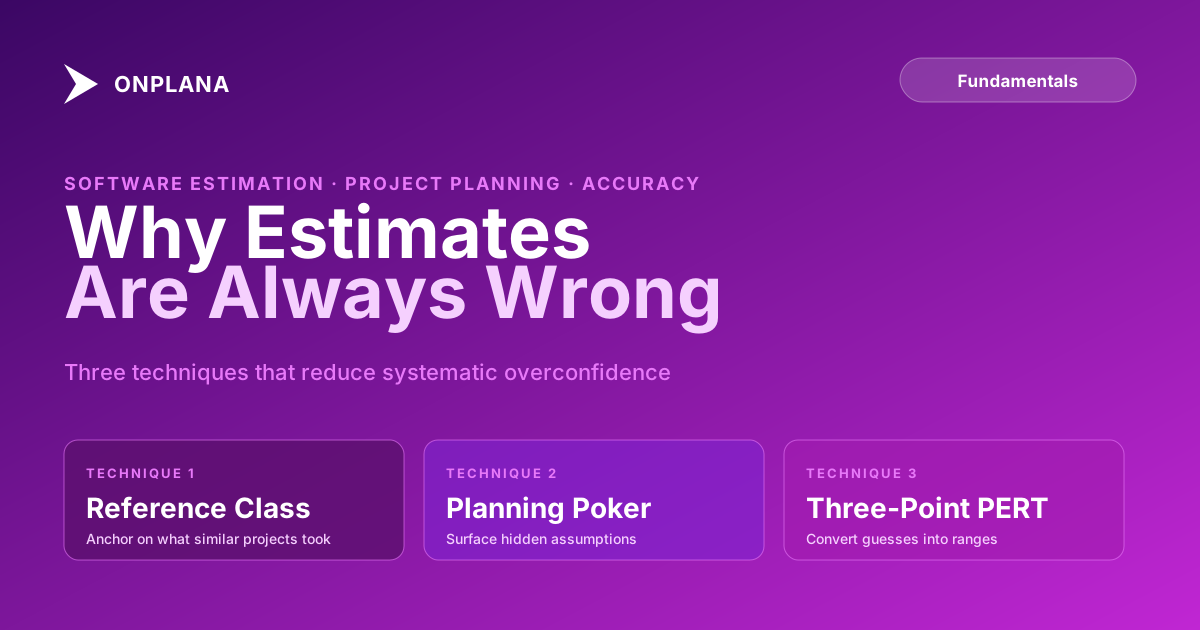
Why Software Project Estimates Are Always Wrong (And How to Be Less Wrong)
Software project estimation fails most when teams anchor on the number the sponsor wants. Reference-class forecasting and PERT are how you reduce systematic overconfidence.
Here is how every optimistic estimate starts. The PM asks the team how long something will take. Each developer gives a number. The PM averages them, trims 20% because the schedule is already tight, and presents a committed delivery date. Everyone in the room knows the estimate is optimistic. Nobody says so, because the date is what was asked for.
Three months later the project is behind schedule. The team is not incompetent. The estimate was never realistic. The planning process optimized for a number that would get approved, not for accuracy. This is not a software failure. It is a software project estimation failure, and it is entirely predictable.
The techniques in this post do not produce perfect estimates. Perfect estimates in complex software projects do not exist. What they produce is estimates with known error bounds, anchored in data rather than optimism, and presentable in terms that make the tradeoffs explicit to whoever is making the funding decision.
TL;DR. Three techniques, used together, reduce systematic overconfidence in software estimates. Reference-class forecasting anchors the range against historical data from similar projects. Planning poker surfaces hidden assumptions in the team's bottom-up estimates. Three-point PERT converts single-point guesses into ranges that account for right-skewed uncertainty. None of them eliminates error; each of them makes the error visible and bounded rather than hidden and compounding.
Why software project estimation fails before the project starts
Software project estimation fails not because the people doing it are bad at math. It fails because of a structural bias in how estimates are solicited and used. The planning fallacy, described by Kahneman and Tversky, is the consistent human tendency to underestimate how long tasks will take even when the estimator has specific, relevant experience with similar tasks that ran late. The fallacy does not diminish with expertise. Senior engineers with decades of software delivery history show the same bias as junior developers making their first estimates.
Two forces amplify the bias in most organizations. First, anchoring: once a number is in the room (the date the business wants, the number the last estimate produced, the budget that was already approved), all subsequent estimates gravitate toward it. A PM who presents a range that does not include the anchor will be asked to explain why their estimate is "pessimistic." Second, the framing of estimates as commitments rather than forecasts. When an estimate is treated as a commitment, the person providing it has an incentive to estimate optimistically and a disincentive to name uncertainty. The result is a number that reflects what is acceptable to say rather than what is actually likely.
PMI's annual Pulse of the Profession survey consistently finds that fewer than half of all projects finish within their original budget and timeline estimates. This is not a new finding and it has not improved significantly over the decades the survey has run. The problem is not that PMs are getting worse; it is that the estimation process itself is structurally biased in the same direction every time. The techniques below address the structural bias, not just the individual estimate.
What reference-class forecasting is and why it works
Reference-class forecasting is a method developed in response to the systematic optimism that plagues inside-view estimation. The inside view is the natural way most PMs estimate: look at the current project, break it down, estimate each piece, sum the estimates. The outside view asks a different question first: how long did comparable projects actually take, compared to what they estimated?
The method works in three steps. First, identify a reference class: three to five completed projects that are similar to the current one in scope, technology, team structure, or type of uncertainty. Second, measure the ratio of actual duration (or cost) to original estimate across that reference class. If similar projects typically ran 40% over their original schedule, the calibration factor is 1.4. Third, apply the calibration factor to the current bottom-up estimate before presenting it. If the bottom-up estimate is 6 months, the reference-class-adjusted estimate is 8.4 months.
The approach was developed and popularized by Bent Flyvbjerg, who studied cost overruns on major infrastructure and IT projects across decades and geographies. His research found that large projects across multiple industries consistently show the same pattern: initial estimates are optimistic by a predictable margin, the optimism is not reduced by better planning tools, and the only reliable correction is an explicit outside-view anchor. The technique is most powerful for novel or uncertain work where the inside view has the least traction.
The most common objection is that "our project is different." Every inside-view estimator believes their project is different. That belief is part of the planning fallacy. Reference-class forecasting does not assume the current project will perform exactly like past ones; it uses past performance as a prior that can be adjusted with evidence, rather than ignored in favor of optimism.
Why planning poker alone is not enough for software project estimation
Planning poker is a genuine tool for surfacing disagreement within a team's estimates. Each team member privately selects a number representing their effort estimate, then all reveal simultaneously. When estimates diverge significantly, the outliers explain their reasoning, and the conversation that follows typically uncovers assumptions the group would not otherwise have made explicit. A developer who estimates 2 days and a developer who estimates 8 days for the same task are usually not disagreeing about the work; they are operating on different assumptions about scope, dependencies, or technical approach.
The limitation of planning poker is that it addresses team-level disagreement, not project-level systematic bias. Planning poker produces a consensus estimate among the people in the room; it does not correct for the fact that every person in the room shares the same optimistic bias, the same organizational pressure, and the same desire to give a number that will get the sprint approved. Social dynamics also introduce pressure: even with simultaneous reveal, the first person to explain their reasoning sets a reference point for the discussion, which can pull outliers back toward the center even when the outlier's reasoning is sounder.
Planning poker also operates at the task or story level. It says nothing about how uncertainty accumulates across a project containing hundreds of tasks, or how the reference class for the overall project compares to the sum of individual task estimates. Use planning poker for sprint planning and task breakdown, where its strengths in surfacing assumptions are most valuable. Do not use it as the sole technique for a project-level delivery estimate, where reference class and three-point estimation add information that planning poker cannot.
Three-point estimates and when to use them
A three-point estimate replaces a single-point estimate with three values: optimistic (O, the best plausible case if everything goes well), most likely (M, the realistic expectation under normal conditions), and pessimistic (P, the worst plausible case if the identified risks materialize). The PERT formula converts these into an expected value: (O + 4M + P) / 6. The weighting gives four times the importance to the most likely case, while allowing the optimistic and pessimistic ends to pull the expected value in their direction.
The standard deviation of the estimate is (P - O) / 6. This measures how wide the uncertainty range is. A task where O = 3 days, M = 5 days, and P = 7 days has a standard deviation of 0.67 days and relatively tight uncertainty. A task where O = 3 days, M = 5 days, and P = 21 days has a standard deviation of 3 days and much wider uncertainty, typically because the pessimistic scenario involves a dependency or technical risk that could multiply the effort.
Consider a worked example with five tasks:
| Task | O | M | P | Expected (PERT) | Std Dev |
|---|---|---|---|---|---|
| API integration | 3d | 5d | 12d | 5.5d | 1.5d |
| Data migration | 5d | 8d | 20d | 9.2d | 2.5d |
| UI build | 4d | 6d | 10d | 6.3d | 1.0d |
| Testing | 3d | 5d | 14d | 5.8d | 1.8d |
| Deployment | 1d | 2d | 5d | 2.3d | 0.7d |
| Total | 16d | 26d | 61d | 29.1d | 7.5d |
The total expected value (29.1 days) is significantly higher than the sum of most-likely estimates (26 days), because right-skewed uncertainty pulls the expected value toward the pessimistic end. The combined standard deviation of roughly 7.5 days means a 95% confidence range extends from about 14 to 44 days. Single-point estimates hide this width entirely.
Three-point estimates are most valuable for tasks with genuine uncertainty about external dependencies, novel technical approaches, or regulatory timelines. For well-understood, repeatable tasks, the additional complexity is not worth the benefit.
The hybrid approach that reduces systematic error
None of the three techniques alone is sufficient. Reference-class forecasting anchors the estimate against history but does not detail the specific work. Planning poker details the specific work but does not correct for systematic optimism. Three-point estimates handle individual task uncertainty but do not address project-level calibration. The combination addresses what each technique misses.
The foundation for all three is a solid work breakdown structure: without a WBS that decomposes scope into estimable work packages, bottom-up estimates have no structure to attach to. See work breakdown structure guide for how to build a WBS before the estimate begins.
Step 1: Anchor with reference class. Before any bottom-up work begins, find three to five completed projects similar to the current one and compute the ratio of actual to estimated duration. Use this as the calibration factor.
Step 2: Detail bottom-up with planning poker. Build the WBS, estimate tasks with the team using simultaneous reveal, and surface the disagreements that expose hidden assumptions.
Step 3: Apply three-point PERT for high-uncertainty tasks. Identify the tasks with external dependencies or novel technical risk. Replace their single-point estimates with PERT calculations.
Step 4: Compare and reconcile. Total the bottom-up estimate and compare it against the reference-class-adjusted range. If the bottom-up is significantly below the reference class anchor, investigate: is there a reason this project should perform better than the reference class, or is the inside view winning again? The comparison is the calibration step.
How to present a software estimate that survives stakeholder pressure
The single structural change that most improves estimate survival under pressure is presenting a range instead of a point. A single number invites negotiation: the sponsor can always ask for less. A range with named assumptions forecloses negotiation on the number and opens negotiation on the assumptions instead.
The format: "Our estimate is 6 to 9 months. The 6-month end assumes the third-party API is available by week 4, the data migration completes with no schema surprises, and we retain both senior engineers through completion. The 9-month end is the expected outcome if one of those assumptions fails. We can commit to 6 months if the business can confirm the API availability by end of this week."
This framing does several things. It shows the work behind the estimate. It names what the PM does not control. It gives the sponsor a concrete action that would change the estimate. And it prevents the PM from absorbing pressure by narrowing the range, because narrowing the range means hiding the risk, not reducing it.
When a sponsor pushes back on the upper end of the range, the correct response is to ask which assumption they believe is safe to remove. If they believe the API will be available, that is their call to make, and they should make it explicitly. The PM's job is to surface the tradeoff, not to absorb it. See 7 hidden killers of an MS Project schedule for the schedule risks that estimates most commonly miss, including dependency gaps that show up only after the plan is committed.
What an honest estimate tells a sponsor
An honest estimate names what it does not know. It says "this assumes the API is available on day 10; if it is not, the estimate extends by three weeks." It says "we have not done this type of integration before; our pessimistic case reflects that." It does not pretend certainty that does not exist.
Sponsors who receive honest ranges with named assumptions make better decisions than sponsors who receive committed points that are later revised. The trust cost of a missed committed date is higher than the discomfort of presenting a range that is wider than the sponsor wanted. A sponsor who is surprised by a schedule slip at month three is less forgiving than a sponsor who was told in month one that the range was six to nine months and chose to plan for the optimistic end.
Honest estimation also changes how projects are resourced. When a sponsor understands that the estimate extends by three weeks if the API is late, they may choose to apply procurement pressure earlier. When they see the data migration risk explicitly quantified, they may assign a data architect to reduce the pessimistic tail. These decisions are only available when the risk is visible.
Run the free Schedule Health Check Upload your .mpp file and get a report on schedule logic integrity, missing baselines, and critical path risks. See what the estimate assumed before you commit the plan. No signup required. → Open the Schedule Health Check
Ready to make the switch?
Start your free Onplana account and import your existing projects in minutes.