What a Change Control Board Should Actually Do
Most change control boards rubber-stamp or bottleneck every request. Here's the decision threshold, meeting cadence, and three artifacts that make a CCB work.
Watch what happens when a change request arrives at most change control boards. The PM submits the form. The board meets two weeks later. The conversation meanders through context the form already covered. Someone asks a question that would have been answered if they had read the attachment. The meeting runs over. The decision comes back as "approved with conditions" that nobody defined. The PM interprets the conditions. Three weeks have passed. The change is already in the schedule whether it was approved or not.
That is not change control. That is change theater: the appearance of governance with none of its function. A change control board has one job: make change decisions faster than the people making them can act without authorization, with enough context to evaluate what each change actually costs the project. When it does that job, it protects the schedule from scope drift and protects the PM from unilateral sponsor pressure. When it doesn't, it becomes the thing the project works around.
The fix is not a better form. It is a clearer mandate, a sharper threshold, and three artifacts that make every meeting fast and every decision defensible.
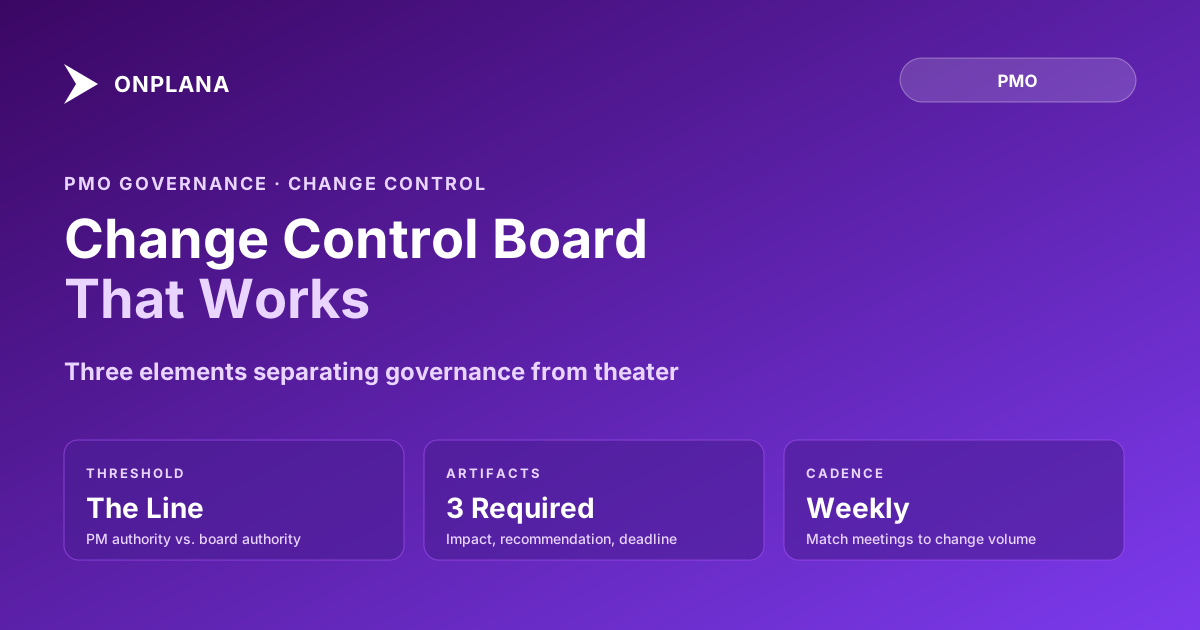
TL;DR. A change control board needs a decision threshold (what change requires board approval versus PM authority), a standard three-artifact submission format (impact statement, recommendation, and decision deadline), and a meeting cadence matched to the project's change volume. Boards that approve everything fail from overload; boards that approve nothing fail from irrelevance. The threshold is the only variable that separates them.
What a change control board is supposed to control
The change control board is a governance structure, not an approval queue. Its purpose is to ensure that changes to project scope, schedule, cost, or quality baselines are evaluated against the project's objectives before they are accepted. The board does not decide whether changes are good ideas. It decides whether the project can absorb them without compromising the commitments it was chartered to deliver.
That mandate is narrower than most boards operate. A CCB that reviews every minor scope addition is processing tickets, not providing governance. A CCB that reviews only catastrophic failures is ceremonial. The board that works sits exactly between those extremes: it sees the changes that would move baseline dates, reopen approved budgets, or shift risk beyond what the PM can accept unilaterally.
Formal project management frameworks recognize this structure under different names. PRINCE2 calls the equivalent function the Change Authority: a delegated body that evaluates change requests against the approved project baseline before they can be absorbed. The mechanism differs by framework; the principle does not.
There are four types of changes that belong in front of the board:
- Scope additions or removals that move the critical path by more than a defined threshold. The specific number depends on the project, but most organizations set it at three to five working days. Changes smaller than that threshold stay at the PM level.
- Budget changes above a cost authority limit. Define this in the project charter. A common threshold for mid-sized projects is $10,000 to $25,000; enterprise PMOs often set it at $50,000 or a percentage of the approved budget.
- Quality standard changes. Any change to what "done" means, including test acceptance criteria, compliance standards, or deliverable definitions.
- Risk class changes. If a change introduces a new category of risk, such as a security exposure or a regulatory implication, it belongs at the CCB regardless of whether it otherwise meets the threshold.
Everything else goes through the PM, within the PM's established change authority. This is not bureaucratic minimalism; it is what allows the board to operate at a pace that does not slow the project.
The three failure modes of boards that do not work
Change control boards fail in one of three ways, and each has a distinct pattern.
The rubber stamp. The board approves everything because declining a change request requires a rationale that nobody wrote down. Change requests arrive without impact assessments, so the board has no basis for rejection. After a few cycles, the board loses credibility: why submit a form if approval is automatic? The PM stops submitting anything borderline. By the time scope is genuinely out of control, the board has lost the information flow to know it.
The bottleneck. The board rejects or defers more than it approves, not because the changes are unjustifiable, but because the submission quality is poor and the board uses poor submissions as a reason to defer. Change requests wait two to four weeks for a board meeting, by which point the project has already moved on and the change is either moot or absorbed without approval. The bottleneck trains the team to stop using the board.
The oracle. The board approves changes but does not own their consequences. The PM implements approved changes. Six weeks later the project is behind. The sponsor asks why. Nobody remembers that the CCB approved three changes to the critical path. The board approved without establishing accountability, so there is no feedback loop between the board's decisions and the project's outcomes.
All three failure modes have the same root cause: the board was assembled without a decision threshold, standard submission artifacts, or accountability for the changes it approved.
The decision threshold: the only variable that matters
The decision threshold is the line that separates what a PM can approve unilaterally from what requires board authorization. Setting it correctly is the most important configuration decision in establishing a CCB.
Too low, and the board reviews everything. Too high, and the PM absorbs scope without oversight.
The diagram below shows how threshold level maps to board workload and residual project risk.
A calibrated threshold for a medium-complexity project (six to eighteen months, cross-functional, $500K to $5M budget) typically looks like this: board review is required when a change would move a critical path task by three or more working days, increase the approved budget by more than $25,000, or introduce a new risk category. All other changes are PM authority. Document it in the project charter and the CCB terms of reference. Review it at each project phase transition; the right threshold for execution may be different from the right threshold for closeout.
The three artifacts every change request needs
The most common reason CCB meetings run long and decide little is that change requests arrive without the information the board needs to decide. The board then spends the meeting time reconstructing context that should have been submitted in writing.
Every change request submitted to a CCB needs exactly three artifacts. Nothing else is required; anything less makes the meeting impossible.
Artifact 1: Impact statement. What does this change affect, in specific terms? Schedule impact in working days (not "some delay"). Cost impact in dollars (not "TBD"). Scope affected: which deliverables, which workstreams, which dependencies. A one-page impact statement with these four fields is enough. A change request without an impact statement is not ready for board review; send it back.
Artifact 2: Recommendation. What does the PM recommend the board decide, and why? A recommendation states a specific decision option (approve, reject, defer to phase 2, or approve with modified scope), a rationale in two to three sentences, and any conditions on approval. The recommendation does not have to be "approve." A PM who recommends rejection because the change conflicts with the critical path is doing exactly what the board needs. Without a recommendation, the board improvises, and improvised decisions are slower and less defensible.
Artifact 3: Decision deadline. When does the project need an answer to stay on track? A change request without a deadline gives the board permission to defer indefinitely. Most CCB deferral patterns trace back to this single omission. The deadline should be the actual date the project schedule turns on the decision, not a polite suggestion. If the deadline is two weeks away and the board meets weekly, the change goes on the next meeting's agenda as a priority item.
Submit all three artifacts in writing 72 hours before the meeting. No exceptions. A board that accepts verbal walk-throughs in the meeting is trading speed of submission for quality of decision.
Meeting cadence and structure
The CCB meeting cadence should match the project's change velocity, not the organization's standard meeting schedule.
For a project in active execution, weekly 30-minute meetings are appropriate if change volume is moderate (three to five requests per week). For a project in planning or closeout with low change volume, bi-weekly is right. For a project in crisis with high change volume, standing daily 15-minute triage sessions are more useful than weekly comprehensive reviews. Mismatched cadence is one of the most common structural problems in CCB operation: a weekly board on a project with ten changes per week becomes a queue; a bi-weekly board on a project with no changes becomes a formality everyone resents attending.
The meeting itself has three blocks:
- Decisions on submitted requests (70% of the time). For each request: the PM walks through the three artifacts in two minutes, the board asks one clarifying question if needed, the board votes. If the board cannot decide in five minutes per request, the request was not submitted with sufficient artifacts. Table it, send it back for revision, and reschedule.
- New change intelligence (20% of the time). The PM surfaces anticipated changes that have not reached the submission stage yet. No decisions are made; the board is informed and can anticipate.
- Open decision log review (10% of the time). The PM reads back the open items from the decision log: approved changes in implementation, rejected changes awaiting sponsor acknowledgment. The board confirms nothing has stalled.
After each meeting, the decision log is updated and circulated within 24 hours. Every approved change gets an owner and a date. Every rejected change gets a formal rationale the sponsor can review. No verbal approvals, no implied consent from silence.
Who should sit on the change control board
CCB membership follows the same logic as the decision threshold: include everyone whose resources or commitments a change might affect, and no one whose attendance does not change the quality of decisions.
For a standard mid-market project, the right membership is: the project sponsor (or a delegate with authority to commit budget), the project manager, the heads of each function whose work is on the critical path, and a PMO representative if the organization has a PMO.
Do not include all functional managers, all stakeholders, or the whole project team. A board of more than six is a status meeting. Keep the membership lean enough that every attendee has a vote that changes outcomes.
For a program or portfolio-level CCB, add a portfolio manager and a finance representative. The structures in discipline, goals, milestones, and status reporting describe how CCB decisions feed into the broader reporting hierarchy; the CCB is not the only governance layer, and its decisions should be visible to the upstream levels.
How to tell when the board is working
Decision velocity is the primary indicator. A board operating at the right threshold makes decisions within five working days of a complete submission. Anything longer indicates that either the submission quality is poor, the board's calendar is too infrequent, or the threshold is set too high and decisions are being escalated to parties who are not available.
Decision reversal rate is the secondary indicator. Approved changes that get reversed within one project cycle (because conditions were not properly evaluated) indicate the recommendation artifact is missing or ignored. Rejections that get overridden by sponsor pressure indicate the board's mandate is not supported at the right organizational level.
If either indicator is off, the PMO Maturity Assessment covers change governance as one of its dimensions. Teams that score low on change governance consistency are usually missing either the decision threshold or the submission artifact standard, and the assessment identifies which gap is driving the problem.
What the board is not
The change control board is not a scope approval authority for the project sponsor. A sponsor who uses the CCB to approve their own scope additions is not using governance; they are using process to legitimize unilateral decisions. The board exists to evaluate changes against project commitments, not to ratify requests from the person who approved the project.
The board is not a design committee. Change requests are not the venue for redesigning the deliverable. If the change request surfaces a fundamental disagreement about what the project should build, that conversation belongs at the steering committee, not the CCB. The CCB decides whether to absorb a change within the current project; the steering committee decides whether to redefine the project.
The board is not a project catch-up meeting. Status reporting belongs in status reports. A CCB meeting that spends 20 minutes on schedule status before reviewing change requests has the same structural problem as the steering committee that informs instead of decides: the agenda communicates priorities, and putting status first communicates that information sharing matters more than governance.
The PMO Maturity Assessment includes a change governance module that scores your CCB setup against five maturity levels, from ad-hoc ("all changes go to the sponsor directly") through optimized ("calibrated threshold, automated decision log, real-time scope baseline tracking"). Most PMOs discover they are operating at level 2 or 3 and can reach level 4 with two structural changes: a written threshold and a submission artifact standard.
For teams where scope discipline is also failing at the earlier stage, before changes even reach the CCB, the three conversations that stop scope creep cover the conversational layer that the formal CCB process depends on. The conversations prevent scope from arriving unannounced; the board governs what arrives through the formal channel.
Run the free PMO Maturity Assessment Score your change governance alongside escalation, scope management, and reporting against five PMO maturity tiers. Get a one-page capability profile in about ten minutes. No signup required. → Open the assessment
Ready to make the switch?
Start your free Onplana account and import your existing projects in minutes.